Nanotechnology and Art
 Among the various innovations and discoveries, Nanotechnology has been of growing importance and usefulness. Many engineers and developers have began to create devices from biological as well as mechanical roots in order to allow for greater ability. By definition, in order to be considered Nanotechnology, a device needs to be less than 100 nano-meters, a distance invisible to the naked eye.
  In order to demonstrate its practical ability and importance, Professor of Mechanical Engineering at University of Michigan, John Hart developed infinitesimally small faces of president Barack Obama. Using Carbon fibers, Hart and his team created a chemical reaction which produced a series of cylindrical tubes that ultimately formulated the faces we see in a birds eye view. Each cylindrical tube, was created using intricate programming and is the size of less than a hundredth of a nano-meter.
  Recently, biologists have developed DNA Nanotechnology in which machines, made from organic material play role in assembling chemical structures necessary for further research. Such an innovation required an artistic and innovative mindset in order to produce such beautiful biological programming. In many respects, the creation of such machines is in itself an art-form.
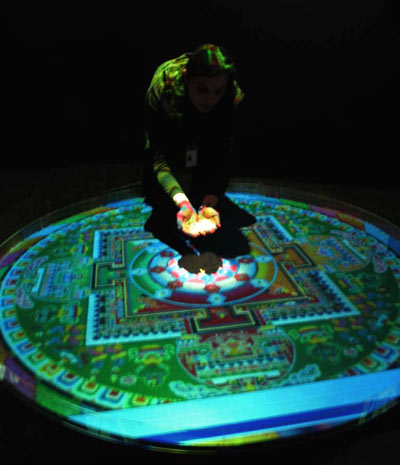 Developers from Switzerland helped create a sand mandala that is not only created on a nano microscopic scale but is also interactive for users in the exhibit at the Children's Museum. The motions and manipulations of the sand are done electronically while a projector magnifies the image allowing users to view their microscopic manipulations on a screen. Thus users are better to visualize the effect of their tiny, microscopic movements. Such a concept, not only is artistically powerful but is demonstrative of the powerful and wide reaching effects that nanotechnology will have in the future.
Works Cited
1. "NANOBAMA." NANOBAMA. Web. 21 May 2016.
2. "NANOMANDALA: Description and Technical Set-up." NANO. UCLA. Web. 21 May 2016.
3. Muscat, Richard, and Wenjing Meng. An Autonomous Molecular Assembler for Programmable Chemical Synthesis. Web. May-June 2016.
4. Malcolm, Chris. "Art in the Age of Nanotechnology." Visible Space. Web. 21 May 2016.
5. Lovgren, Stefan. "Can Art Make Nanotechnology Easier to Understand?" National Geographic. National Geographic Society. Web. 21 May 2016.
6. Feder, Barnaby J. "The Art of Nanotech." Bits The Art of Nanotech Comments. Web. 21 May 2016.

No comments:
Post a Comment