Tuesday, June 7, 2016

Extra Credit Event Blog Post

Getty Museum

A few weeks Ago, I decided on taking a trip to the Getty Museum with a few friends. Though, my reasons for going were a tad different than those of my friends, I learned much the various specialties within the science of Art. 
Initially, when walking in, I was amazed at the regal style of the venue. The Getty's exterior epitomizes the modern conception of a royal palace. With stone like surfaces and castle like structures, the Getty displays visually pleasing architecture. 
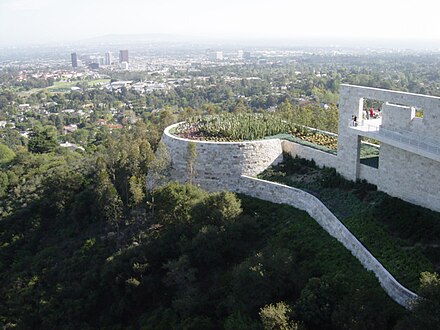


Oddly enough, when examining the beauty behind such structures, I was reminded of our class lectures, discussing concepts like the golden triangle and other geometric principles involved with producing such symmetric buildings.

In many respects, it can be argued that perhaps the engineers and architects who designed the building must have been influenced by the Greek structure, the Parthenon. Both structures sit atop a hill, overlooking a dramatic view. Furthermore, each structure implements the use of columns that offer structural support to the rooftop.

When examine the museum itself, I was intrigued at the various types of artworks on display. Ranging from various sculptures and canvasses with sharply painted figures, it was initially hard to find what topic or artwork to hone in on. However, one artwork that continues to linger in my thoughts is George Herms's untitled portrait. Though it may not offer anything "special" in comparison to the works, it caught my eye due its blue color that reminded my of Megan Lindeman's picture in which she mixed oxytocin in her pigment of blue; the resulting color looks eerily similar to this portrait's shade. 


Works Cited:

Lindeman, Megan. "Megan Lindeman." Megan Lindeman. N.p., n.d. Web. 08 June 2016.

"Greek Architecture - Crystalinks." Greek Architecture - Crystalinks. N.p., n.d. Web. 08 June 2016.

"Architecture in Ancient Greece | Essay | Heilbrunn Timeline of Art History | The Metropolitan Museum of Art." The Met's Heilbrunn Timeline of Art History. The Metropolitan Museum, n.d. Web. 08 June 2016.

"Untitled (Getty Museum)." The J. Paul Getty in Los Angeles. N.p., n.d. Web. 08 June 2016.

"Golden Ratio in Art Composition and Design." The Golden Ratio Phi 1618. The Museum of Harmony and Golden Section., 2014. Web. 08 June 2016.


Sunday, May 29, 2016

Event Post 3

IPAM
 Last Friday, I attended Dr. Vwani P. Roychowdhury's lecture  regarding NLP, or Natural Language Processing. 

Dr. Roychowdhury's  machine or "algorithm" takes in text and interprets it into meaningful data. One example of his output, were his results form using twitter feed information regarding vaccination, in which the program clustered words and statements into groups. For example,  Dr. Roychowdhury's design was able to find the exact political opinion of mothers against vaccinations and associate a list of verbs associated with controversial nouns.

Another important action, his program performed was the vast clustering of related information. When his program was fed blogs and other websites contain petabytes of data(over billions of words and text), all pertaining to a certain topic, the program was able to organize information and correlate an important information in clusters. Clusters are a visual representation of information that indicate the size and correlation of many types of data. Therfore, in many respects the design of such a program, allows for computers, in a sense, to critically analyse a topic.  

Initially, when pondering how to connect such a dense topic to the material learned in class, I faced difficulty. 
However, it is clear to me now, that such a topic in fact, requires great artwork. For example, much of the commands to organize clusters of information requires an artistic mind to organize such information in a visually pleasing manner. 

Furthermore, in order to create commands for a computer to both efficiently and methodically carry out, great thought must be taken into consideration before doing. Just as a painter exerts creative thought onto his canvas, so too does a developer using his NLP algorithms. Additionally, much of the same mental faculties required in producing artwork, goes into developing code as many skilled programmers have noted.


Works Cited

"Big Data and Complex Networks Group." Big Data and Complex Networks Group. UCLA. Web. 30 May 2016.

Duygulu, P., and K. Barnard. "Clustering Art." Clustering ArtIEEE Xplore. Web.

Guyon, Isabelle. "Clustering: Science or Art." Stanford University. Web.

Moore, Barbara. "Art 1 and Pattern Clustering." MIT. Web.

Rijmenam, Mark Van. "Datafloq - Connecting Data and People." Datafloq Read RSS. Datafloq. Web. 30 May 2016.

Week 9 Space and Art

Space and Art


In May 2016, NASA announced its release of the NODE, or Network and Operation Demonstration Satellite. This engineering marvel implements nanotechnology for more efficient storage of data and power usage thus providing great use for the next ISS mission. This technology not only demonstrates the potential for greater discoveries of the cosmos, but also serves as a an example of the artwork needed to produce such an engineering marvel. With its visually pleasant cubic shape, more surface area is granted for storage of data in the form of grids.

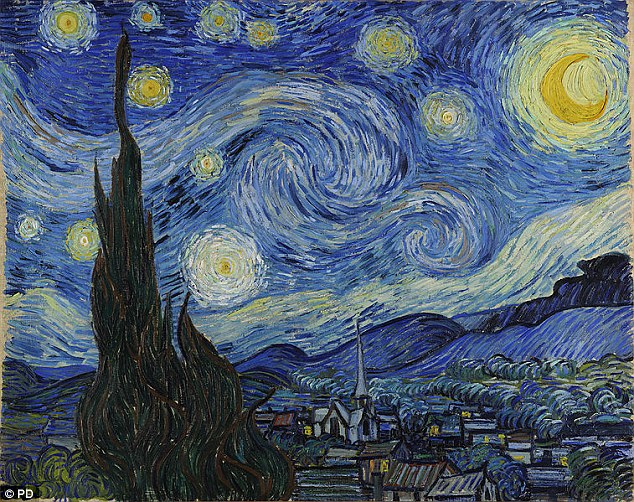
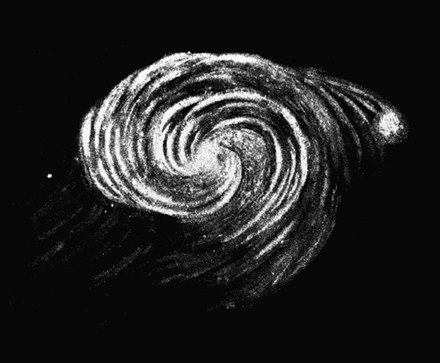
Vincent Van Gogh's Starry night shows how discoveries of the cosmos offer an  avenue of creative artworks. Recent analysts of great artworks have hypothesized that Van Gogh's swirls in the starry sky originated from scientific observations during the same time as his career, in the 1850s. Anglo-English astronomer, William Parsons discovered M51, the first Whirlpool galaxy and had even created drawings that closely resemble those of Van Gogh's illuminated night sky.


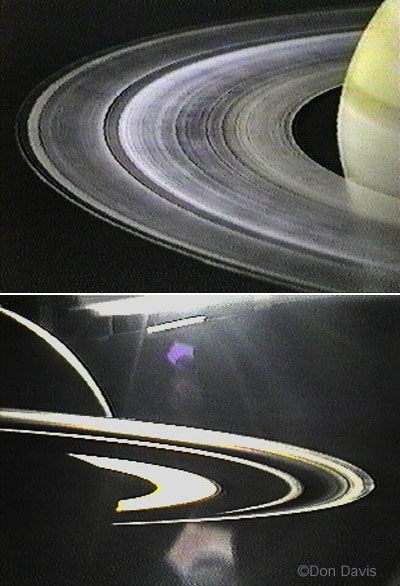
Painter and Animator Don Davis, after his efforts collaborating with many astronomers, constructed a wide range of planetary objects and their surfaces to expose and signify features almost unknown in  many drawings and other artworks. One such example is his construction of Saturn's rings. Using Plexi Glass and specific coloring mechanisms, Davis was able to enumerate the icy and rocky surface of each layer of rings that Saturn Contains.
This month, two street artists Pietro Zucca and EMMEU inspired with the science behind star explosions, or Supernovae, constructed an art show in which an auditorium was devoted to still shots that changed frame by frame of geometric shapes. Each simulated an explosive and vibrant array of particulate matter in the form of a variety of polygons. Without the astronomical discovery of supernovae, such a rare viewing would be non existent. Likewise, without both artists and their creative tools, much of the public would remain ignorant of the power and awe of  supernovae.

Works Cited
Caldwell, Sonja. "Nodes – Network & Operation Demonstration Satellite." NASA. NASA. Web. 29 May 2016.

Davis, Don. "Don Davis Space Art." Don Davis Space Art. Web. 29 May 2016.


"Solo Exhibition SUPERNOVA by EMMEU and Pietro Zucca. Roma, Italy - I Support Street Art." I Support Street Art. Web. 29 May 2016.

Jones, Jonathan. "Starry, Starry Night: A History of Astronomy in Art." The Guardian. Guardian News and Media, 2014. Web. 29 May 2016.

MailOnline, Jonathan O'Callaghan for. "Is Van Gogh's Starry Night a Painting of GALAXIES? Bright Swirls Are Based on Distant Cosmic Spirals, Claims Expert." Mail Online. Associated Newspapers, 2015. Web. 29 May 2016.

Wheery, Phil. "Rosse Sketches Photo Index." Rosse Sketches Photo Index. Web. 29 May 2016.

Tuesday, May 24, 2016

caseykDESMA9: Week 8: Nanotech and Art

Dead Casey, I also found nanotechnology's application to the medical field fascinated. And I enjoyed how you incorporated with videos to explain your point.

Saturday, May 21, 2016

Week 8 Post

Nanotechnology and Art

Among the various innovations and discoveries, Nanotechnology has been of growing importance and usefulness. Many engineers and developers have began to create devices from  biological as well as mechanical roots in order to allow for greater ability. By definition, in order to be considered Nanotechnology, a device needs to be less than 100 nano-meters, a distance invisible to the naked eye. 

In order to demonstrate its practical ability and importance, Professor of Mechanical Engineering at University of Michigan,  John Hart developed infinitesimally small faces of president Barack Obama. Using Carbon fibers, Hart and his team created a chemical reaction which produced a series of cylindrical tubes that ultimately formulated the faces we see in a birds eye view. Each cylindrical tube, was created using intricate programming and is the size of less than a hundredth of a nano-meter.  

Recently, biologists have developed DNA Nanotechnology in which machines, made from organic material play  role in assembling chemical structures necessary for further research. Such an innovation required an artistic and innovative mindset in order to produce such beautiful biological programming. In many respects, the creation of such machines is in itself an art-form.

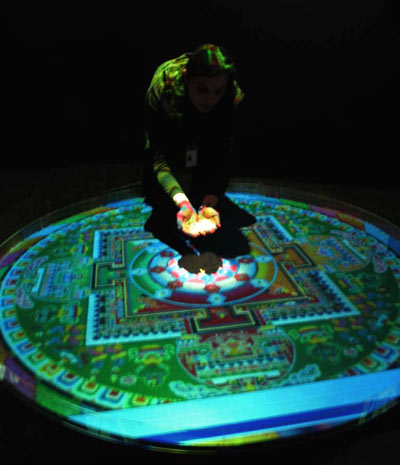
Developers from Switzerland helped create a sand mandala that is not only created on a nano microscopic scale but is also interactive for users in the exhibit at the Children's Museum. The motions and manipulations of the sand are done electronically while a projector magnifies the image allowing users to view their microscopic manipulations on a screen. Thus users are better to visualize the effect of their tiny, microscopic movements. Such a concept, not only is artistically powerful but is demonstrative of the powerful and wide reaching effects that nanotechnology will have in the future. 
Works Cited
1. "NANOBAMA." NANOBAMA. Web. 21 May 2016.

2. "NANOMANDALA: Description and Technical Set-up." NANO. UCLA. Web. 21 May 2016.

3. Muscat, Richard, and Wenjing Meng. An Autonomous Molecular Assembler for Programmable Chemical Synthesis. Web. May-June 2016.

4. Malcolm, Chris. "Art in the Age of Nanotechnology." Visible Space. Web. 21 May 2016.

5. Lovgren, Stefan. "Can Art Make Nanotechnology Easier to Understand?" National Geographic. National Geographic Society. Web. 21 May 2016.

6. Feder, Barnaby J. "The Art of Nanotech." Bits The Art of Nanotech Comments. Web. 21 May 2016.

Friday, May 20, 2016

Event Post...Lasers

   
Event post: Fourth State of Matter
After attending,  Dr. Geckelberg's seminar on Plasma and the nature of its physical research, I was enthralled surprisingly not only at the scientific applications, but more so at useful artistic value that the data can draw. 

One such example, was the how the display of Dr Geckelberg's findings were presented in puzzling yet intriguing loop-like and colorful rings. Not only are such findings crucial to understand the vector fields in question, but they also happen to produce magnificent artwork. 

In addition to Dr. Geckelman's findings, Artist Megan Lindman spoke of the various impacts that certain chemicals like Oxcytocin impact our capacity to love others and seek pleasure. Following her explanation, she displayed her paintings in which part of each color had actual Oxytocin  mixed into the shades. Ultimately, to produce a more visually appealing portrait. In my opinion, her lecture signified the codependency that science has with Art. Although art often is seen to be abstracted away from the various sciences, much of the inspiration behind artful pieces such as mrs. Lindman's depend on inspiration of science. Likewise, without artists and other creative thinkers, it is impossible to internalize such ideas and feelings
without the useful display of art.


Such examples not only enlighten me on the scientific applications to art, but also inspire me to possibly take a subject seemingly distant from art and draw meaningful and intensifying pieces of art. 

One interesting, controversial, and yet revolutionary implementation, is the use of robots in art production. Using various programs involving randomized sampling in Statistics, computer programs can simulate various shapes, textures, and color combinations to plot on both 2D and 3D surfaces, thus offering more possibilities for jaw dropping pieces of art.  


Works Cited

"Basic Plasma Science Facility at UCLA." BaPSF. UCLA. Web. 20 May 2016.

González-Banos, Hector. "A Randomized Art-gallery Algorithm for Sensor Placement." Proceedings of the Seventeenth Annual Symposium on Computational Geometry - SCG '01 (2001). Web.

Maeda, John. "Artists and Scientists: More Alike Than Different."Scientific American Blog Network. Web. 20 May 2016.

Pappas, Stephanie. "Oxytocin: Facts About the 'Cuddle Hormone'"LiveScience. TechMedia Network. Web. 20 May 2016.

Wednesday, May 18, 2016

manuelcDESMA9: Neuroscience and Art

Dear Manuel,

I found your commentary on the social norms to be very interesting. Furthermore, I enjoyed your connection and analysis for Freud and his commentary on Human and social desires